Baselang Review (2025): 100+ Hours Later, Is It Still Worth It?
After years of stop-start Spanish learning, I decided 2025 was the year I’d finally commit. No more dabbling. No more Duolingo guilt. Just 1:1 Spanish lessons, daily, with a real tutor. This is my experience using Baselang for an intensive two-month sprint, with honest thoughts on how it stacks up today as an online Spanish option and whether it’s a great program for busy adults who want to learn Spanish in the real world.
Updated December 2025
2025 Update: Real-World Use After 4 Months of Travel
Quick context before we dive in:
Since originally publishing this Baselang review, I’ve now been travelling for over four months across South and Central America and have logged 100+ hours of real conversational Spanish with locals, taxi drivers, shop owners, hosts, neighbours, and other parents across multiple Spanish-speaking countries.
I’m not fluent. Far from it.
But we understand each other and that’s the difference that matters — I’m not a perfect Spanish speaker, but I’m able to speak and be understood.This update reflects what Baselang looks like after the study phase ends and the real world begins. What stuck. What transferred. What didn’t. And whether the time investment actually paid off once Spanish stopped being an “exercise” and became a daily survival skill.
If you’re wondering “Is Baselang still worth it in 2025?” – this review now answers that from both the classroom and the street.
Use my referral link here and get up to $100 off your lessons
Why I’m Using Baselang in 2025 to Learn Spanish (Baselang Spanish Tutoring Service)
When I tell people I’m waking up at 5am every day to study Spanish, before the kids, before work, before caffeine, the usual reaction is, “You’re mad.” But there’s a reason I’m doing this, and it starts with a platform I first tried back in 2016: Baselang.
Back then, I gave it a month and got further than I ever had with apps or textbooks. Life got in the way (met my wife and had kids) but I never forgot how fast I improved when I actually spoke the language daily with real teachers. That daily conversation in Spanish is what moves the needle.
Now in 2025, I’m back stronger than ever because me my family and will be travelling South and Central America for a year, and this time with a plan: two months of intensive study, 2–3 hours a day, rotating between my favourite Baselang teachers. I’m combining it with vocab apps like Memrise and also Dreaming Spanish, but Baselang is the backbone. It’s the closest thing I’ve found to a consistent Spanish tutoring program that fits around real life.
Why Baselang? Because no other platform offers unlimited, on-demand 1:1 tutoring for a flat monthly fee. And for someone serious about making fast progress, especially on a tight schedule, that’s hard to beat. Baselang is basically a tutoring service built for reps, and reps are what you need in order to learn a language.
If you’re searching “is Baselang still worth it?”, I’ve got thoughts. This post will walk you through my current experience, how I structure my lessons, what’s changed since 2016, and whether it’s still the best option for serious Spanish learners in 2025, especially if you want a real world program you can actually stick to.
My Daily Routine with Baselang: Carve Out Enough Time to Learn Spanish
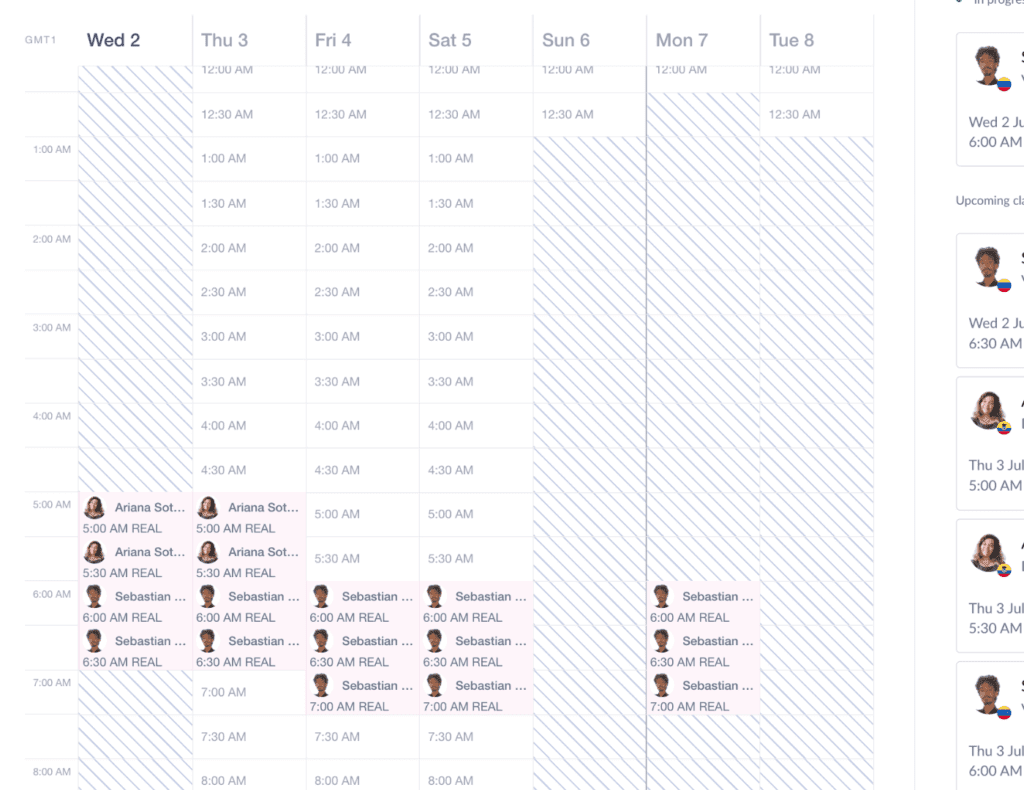
Screenshot showing Baselang class bookings with early morning 5–7AM Real World lessons and Sebastian as the teacher.
When you commit to learning a language, your calendar has to reflect it. For this two-month sprint, I blocked out 5:00–7:00 AM each day for my Baselang sessions. Why so early? Because it’s quiet, consistent, and gives me a win before the day even starts, and it helps me carve out enough time when life would otherwise take over. If you’re wondering if you’ll have enough time to learn Spanish, this is the real answer: you make it boring and repeatable.
We all know how when it get later in the day the excuses start to creep in…Well for me they do anyway.
I rotate between 2–3 teachers I really like, which keeps the sessions fresh but still familiar. My favourite teacher, Sebastián, brings the perfect mix of challenge and patience. he keeps things conversational while still correcting my grammar in real time, which is exactly what I want from a tutor.
Each day follows a loose rhythm:
- 1x 30-minute lesson focus
- 1x 30-minute conversation-based lesson
- Occasional “free talk” days where we just chat about anything (travel, family, cultural quirks)
Outside of class, I pair Baselang with a vocab app for review — just 10–15 minutes a day helps reinforce new words and phrases, and helps my understanding of Spanish stick (even when I’m tired). I’ll usually pick one Spanish word or phrase from the day and force myself to use it later.
The key?
Treating it like a gym session. Book it. Show up. Push through even when tired. Progress happens in the reps, and Baselang’s unlimited model makes that possible.
How Much Progress Can You Really Make with Baselang?
This is the big question, right? Especially when you’re committing daily time and cash.
The short answer: A lot, if you use it right.
Back in 2016, I used Baselang for about a month. Even then, with a less structured routine, I was able to reach a decent conversational level. Fast forward to now, with a more focused system and 1–2 hours a day, I can already feel the shift after just one week. I’m speaking more confidently, making fewer grammar errors, and, crucially,…thinking in Spanish more often. I’m not at fluency, but I’m closer to being able to speak without freezing.
That said, if you’re diving into extensive language learning, especially lots of speaking practice, watch for burnout. I almost hit that wall, too many back-to-back lessons left me mentally drained. I ended up taking an “off” day and came back sharper and more motivated. So pace yourself. It’s a marathon, not a sprint — the time to learn matters as much as the tool.
Baselang’s real strength is immersion without overload. You’re not stuck in flashcards or grammar drills. You’re talking. Listening. Making real-time mistakes and fixing them with a real human. It’s intense but forgiving, and for anyone trying to move from “I kinda get it” to “I can actually speak it,” that’s a game-changer. This is why I think Baselang is a real world program more than a traditional Spanish course.
Progress isn’t linear. Some days you’ll feel fluent, others like you’ve never heard the language. But Baselang gives you the structure and support to keep climbing and it’s why I keep coming back to this Baselang review when people ask what’s actually helped me improve.
What Makes Baselang Different From Other Platforms?
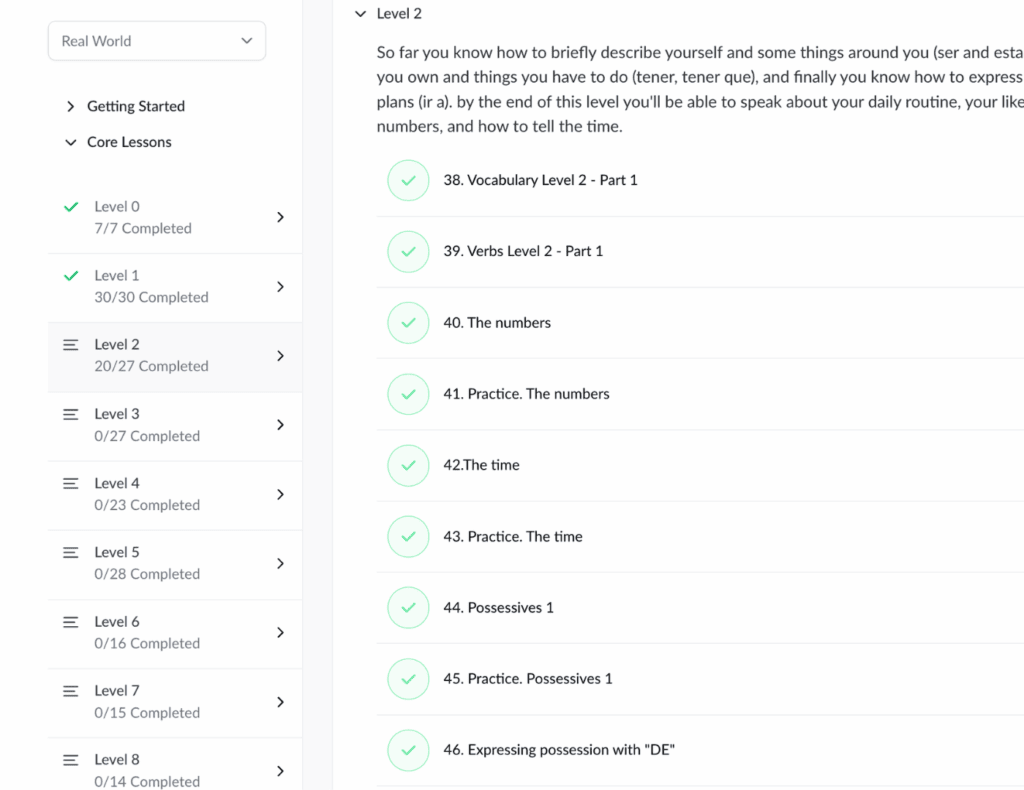
Progress through Baselang’s Real World curriculum showing completed vocabulary and grammar lessons in Level 2.
There are plenty of language platforms out there, italki, Preply, Verbling, all promising native teachers and flexible scheduling. And I’ve tried a bunch of them. But Baselang has carved out its niche with a very specific value proposition: unlimited, one-on-one Spanish lessons for a flat monthly fee. This is the part that sets Baselang apart.
And here’s what that actually means in practice:
No session anxiety: With other platforms, you feel like you need to make every minute count because each class costs money. With Baselang, if a lesson goes badly or your kid interrupts halfway through, no big deal. You can just book another. This is where the “offers unlimited Spanish” idea becomes real, not marketing.
Incredible flexibility: I’m doing lessons most mornings between 5–7:30am UK time, and there’s always a teacher available. You can book 5 minutes before class or set a consistent weekly schedule. Either works. Baselang’s Baselang scheduling is a big part of why I can use Baselang daily.
Curriculum or conversation: Some platforms are rigid. Others are too loose. Baselang lets you choose; you can follow their structured “Real World” curriculum or just have pure conversation lessons. The curriculum is there when you want it, and that matters more than people realise.
Latin America-focused teachers: All Baselang teachers are from Latin America. That means regional vocab, accents, and culture aren’t just side notes, they’re baked in. Many people mention that teachers are from Venezuela (along with other countries), and the exposure to different accents helps with real conversations in a Spanish-speaking country.
But most importantly, the model encourages consistency. If you’re paying for unlimited access, you want to show up. It creates a helpful bit of pressure to build the daily habit. For language learning, that’s huge.
I now know not to say “Embarrsado” (I’m pregnant) when meaning to say I’m embarrassed.
Also don’t refer to your dad as a Papa…trust me.
Get up to $100 off your Baselang plan, just use my link
Get up to $100 off your Baselang plan, just use my link
Baselang vs italki: Which Actually Works for Daily Speaking?
This is the comparison people actually care about, not features on paper, but what gets you speaking consistently.
I’ve used Baselang and italki, and here’s the real difference:
italki is a marketplace.
You choose a teacher, pay per lesson, and hope your schedule, energy, and budget line up long enough to build momentum.
Baselang is a system.
You pay once per month and remove friction, no “is this lesson worth the money?” anxiety, no rationing practice, no guilt about booking more sessions.
For daily speaking, that difference matters more than teaching quality (which is good on both platforms). It also changes how quickly you can move toward fluency, because volume + consistency matters.
Where italki shines
- Great if you only want 1–2 lessons per week
- More language options beyond Spanish
- Easy to “shop around” for teaching styles
Where Baselang wins for speaking
- Flat monthly fee encourages daily use
No mental math per lesson - Easier to build a habit (especially with early mornings or travel schedules)
- Teachers are used to conversation-heavy learners
My takeaway:
If your goal is occasional practice, italki works well.
If your goal is daily speaking, especially before travel, Baselang makes consistency far easier.
Baselang Curriculum: Grammar, Grammarless Program, and Learning With Baselang (Real World + DELE Program)
This is where “does it work?” becomes “how are you using it?”
Baselang’s Real World track is the most practical curriculum if you’re trying to speak in everyday situations. It’s structured, but not stuffy. It feels closer to real life than a textbook Spanish course, and that’s the point.
Baselang also has options like a DELE program, which can be useful if you want formal structure. I personally focus on Real World because I’m learning Spanish to function in real conversations, not pass an exam.
The way I see it: Baselang gives you the choice between:
a structured curriculum
pure conversation
something closer to a grammarless program where speaking comes first and grammar gets corrected on the fly
That flexibility is a huge part of why learning with Baselang works for me.
What Actually Transfers From Baselang to Real-Life Spanish (First Conversation in Spanish)
This is where most language platforms fall apart and where I think Baselang quietly does well if you use it properly.
After four months on the road, here’s what genuinely transferred from my Baselang sessions into daily life:
What stuck
- Listening confidence, I can follow conversations even when I can’t respond perfectly
- Automatic phrases, greetings, clarifications, softeners (“un momento”, “más o menos”, “depende”)
- Comfort making mistakes, this is massive when talking to locals
- Accent familiarity, Latin American Spanish feels natural, not academic — you get used to the sounds of Spanish fast
What didn’t
- Complex grammar under pressure
- Fast group conversations
- Slang-heavy speech without context
Baselang didn’t make me fluent.
But it made me functional, and that’s the bridge most learners never cross. I had my first real conversation in Spanish without switching to English, and that alone justified the time investment.
What I’d Do Differently If I Started Again

Baselang teacher profile of Sebastian Torres marked as favorite with description ‘Mi profesor favorito’.
If I could rewind and start my Baselang journey from scratch, there are a few key changes I’d make, not because the platform didn’t work, but because I understand myself as a learner much better now.
I’d pace myself more intentionally.
In my first few days, I booked back-to-back sessions like a kid let loose in a candy store. While the enthusiasm was great, it nearly led to burnout, especially because so much of the learning is conversation-based. I now build in deliberate off-days or lighter sessions, particularly when I feel mentally fatigued or low-energy. It keeps things sustainable and enjoyable.I’d focus on one core teacher to start.
The beauty of Baselang is the ability to rotate between teachers, but early on I would’ve benefited from choosing one main teacher (like I now do with Sebastián) to build momentum. You can still branch out later, but that initial consistency helps massively with confidence and feedback loops.I’d combine it with spaced repetition vocab from Day One.
It’s tempting to think hours of talking will cement new words naturally, but in reality, my retention skyrocketed when I added a separate vocab routine (I use apps like Anki or Drops on the side). I’d set this up alongside your classes immediately.I’d track small wins weekly.
Fluency is a slow burn, and without tracking, you might feel like you’re getting nowhere, even when real progress is happening. I now jot down “wins” like “Held a full conversation about travel plans without switching to English” or “Used three new subjunctive phrases today.”
In short, I’d still choose Baselang again in a heartbeat, but with a bit more strategy, breathing room, and reflection from the start — and I genuinely think it would help me improve my Spanish even faster.
My 60-Day Plan Ahead
I’m treating this like a language sprint and a personal experiment in consistency. My goal by the end of 60 days is to feel conversationally fluid in everyday topics: travel, family, opinions, basic storytelling. I’m not chasing perfection, just confidence and flow and that’s what I think Baselang is best at.
I’m aiming for 2 to 3 hours of Baselang lessons per day, 5 to 6 days a week. In total, that’s roughly 80 to 100 hours of live Spanish conversation in two months. On top of that, I’ll continue using vocab apps and occasional listening practice (like podcasts or Spanish Netflix episodes) to reinforce everything. It’s basically a bootcamp approach without pretending it’s glamorous.
I’m tracking my progress the old-school way: notes in Notion, a running log of lessons, and weekly reflections on what’s improving and what’s still clunky. I’ll also use Instagram and the blog to document insights and motivation dips, because, let’s be honest, not every day is a win.
And this blog post? Think of it as my “checkpoint at week one.” I’ll be following up with a second post at the 60-day mark with final takeaways, what changed, and whether I hit those fluency goals (or crashed somewhere along the way).
Is Baselang Worth It? (Even After One Week) Baselang Review – Super Great Program?
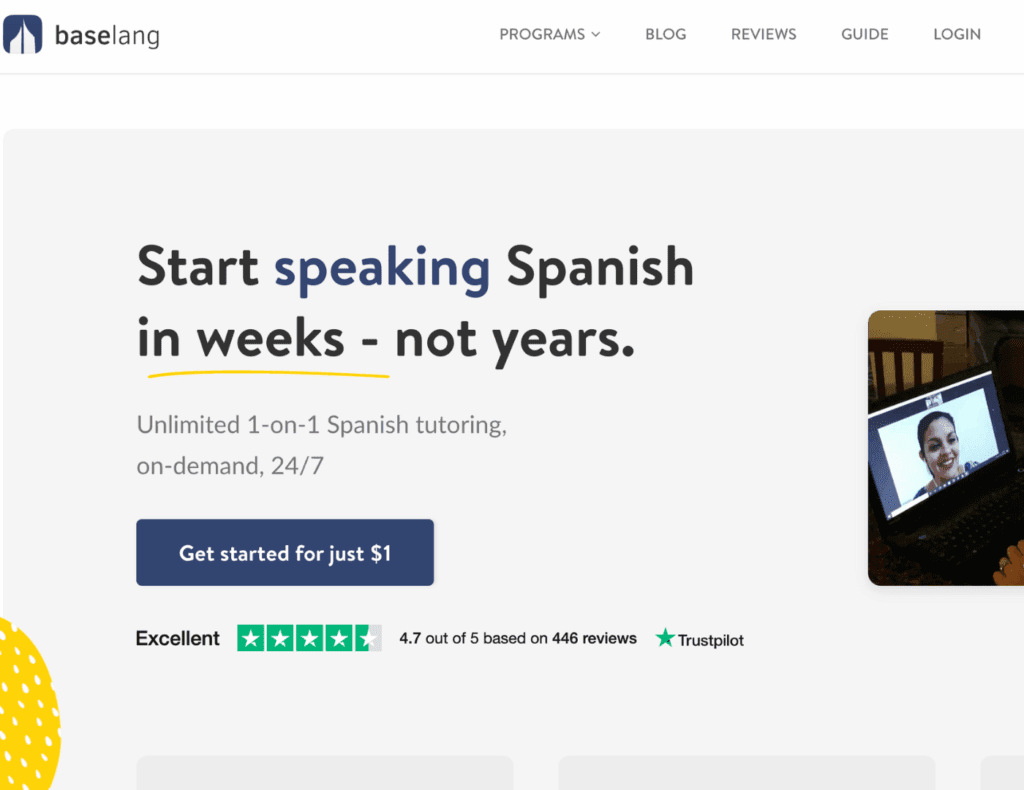
Baselang homepage highlighting unlimited Spanish tutoring for $1 with 4.7 Trustpilot rating.
Honestly? If you’re serious about learning Spanish, not dabbling, but actually putting in the time, Baselang is the real deal.
In just a week of consistent lessons, I already feel more confident, more motivated, and more engaged than I have in years of trying to “self-study” through apps and podcasts. The unlimited format removes the pressure of perfection. You just show up, talk, learn, repeat.
Is it cheap? Not exactly. But compared to paying for private tutors by the hour, especially at the volume I’m doing, it’s phenomenal value. (Works out around $2-3 an hour) You get access to passionate teachers, a flexible platform, and a structure that rewards your effort.
Would I recommend it to other parents, busy adults, or long-term travellers trying to learn Spanish before a trip? Absolutely. If you want to learn and you can carve out the time, I genuinely recommend Baselang as a Spanish tutoring service that delivers.
I’ll be checking back in after my full 60-day sprint with more insight and lessons learned. But for now? I’m all in.
Use my referral link to save up to $100 on your Spanish lessons
I only recommend tools I actually use, and Baselang is something I’ve paid for, used daily, and relied on while travelling. This link gives you a discount and helps support the site, but it doesn’t change what I’ve written here.
I only recommend tools I actually use, and Baselang is something I’ve paid for, used daily, and relied on while travelling. This link gives you a discount and helps support the site, but it doesn’t change what I’ve written here.
Baselang FAQs (2025)
Is Baselang really unlimited?
Yes, within fair use. You can book as many lessons as you want, but availability depends on time of day. Early mornings and late evenings are gold.
How much does Baselang cost per month?
Baselang runs on a flat monthly fee model. When used consistently, it works out to $2–3 per hour, which is almost impossible to beat for 1:1 tutoring.
Can you become fluent using Baselang alone?
No, and that’s true of any platform. Baselang works best when paired with listening input and vocab review. Think of it as the speaking engine, not the entire system.
Is Baselang better than Duolingo?
They serve different purposes. But i would say YES. Duolingo is passive and habit-based. Baselang is active and effort-based. If your goal is speaking, Baselang wins, but it demands more from you.
How long does it take to see progress?
With daily use, most people notice a shift in confidence within 1–2 weeks. Real conversational ability takes months, especially once you start using it outside lessons.