
This is a sponsored post, but we’ve kept it focused on what actually matters when you’re travelling.
If you’re planning a trip, sorting your data before you land is one of those small things that makes a big difference. We’ve learned that the hard way, especially arriving somewhere new with no connection and trying to figure it out on the spot.
In this guide, we’re breaking down how travel eSIMs work, what to look for, and the options available right now so you can decide what actually makes sense for your trip.
By 2026, the mobile communications market had definitively moved beyond physical SIM cards. What began as a convenient feature for owners of the latest iPhone models has evolved into a global standard for travel. Today, choosing the right eSIM provider is not just a matter of saving a few dollars on roaming. It is a matter of data security, a stable connection for digital nomads, and the ability to instantly access local services in over 185 countries worldwide.
The e-commerce industry in the telecom sector is experiencing aggressive growth. According to the latest reports from Juniper Research, the number of eSIM activations in 2026 has grown by 180% compared to three years ago. Consumers have become more demanding: it is no longer enough to simply have “some kind of internet.” Travelers need low latency, support for 5G frequency aggregation, and a transparent billing system with no hidden fees for “profile maintenance.”
Why eSIMs Are Travel Essentials
The evolution of travel has always been inextricably linked to access to information. By 2026, reliance on the internet had become absolute. From biometric lanes at Singapore’s airports to contactless payments at Lisbon’s coffee shops — everything depends on a stable connection. Physical SIM cards are becoming a thing of the past for several objective reasons worth examining in detail.
First, there’s device security. A physical SIM card slot is an extra opening in the device’s casing that reduces water resistance and creates a vulnerability in case of phone theft. A thief can easily remove your card to cut off the connection to the “Locator” service. With an eSIM, this trick won’t work: the digital profile is password-protected and tied to the device’s hardware.
Second, logistics. Searching for a mobile service kiosk at the airport after a 12-hour flight is a dubious pleasure. Often, local carriers push tourists into buying excessive minute packages they don’t need, or require passport scans at shady sales points. eSIM technology lets you take care of this while you’re still packing your suitcase.
Finally, there’s multi-profile capability. Modern smartphones allow you to store up to 8–10 eSIM profiles simultaneously. This gives travelers unique flexibility: you can keep your home line active for SMS messages from banks while simultaneously using a cheap data plan from PrimaSim or Airalo for browsing.
What to Look for in a Travel eSIM
Before diving into a direct comparison of brands, it’s important to understand the criteria professionals use to evaluate service quality. In 2026, simply comparing “price per gigabyte” is no longer enough. Experts identify four key pillars of a reliable connection.
Infrastructure Quality and Tier Status of Partners
Not all eSIMs are created equal. Providers like PrimaSim work directly with Tier-1 carriers (such as Orange in Europe or AT&T in the U.S.). This guarantees network priority. Cheap budget providers often use second- or third-tier MVNO intermediaries, which is why in crowded areas (stadiums, train stations) the connection drops to 3G speeds, even if the 5G icon is lit up on the screen.
Fair Usage Policy (FUP)
Many carriers that advertise “unlimited internet” are being misleading. The fine print often states that after using 2 GB per day, the speed drops to 128 kbps. By 2026, this effectively means no connection. When choosing a provider, it is critically important to look for transparent limits.
Hotspot Support (Internet Sharing)
For those who work on the go, the ability to share an internet connection with a laptop is essential. Some providers (specifically, Holafly in certain regions) block tethering on unlimited plans. This is something to keep in mind when planning business trips.
Automatic network switching (Steering of Roaming)
The best providers allow eSIMs to connect to multiple cell towers from different operators within a single country. If the Vodafone network is weak at a given location, a high-quality profile will automatically switch the device to Telefonica without user intervention.
Quick Comparison Table
The table below provides a summary of key market players for the current 2026 season. The data is based on publicly available pricing plans and technical specifications from providers.
Parameter | PrimaSim | Airalo | TooSim | Holafly |
Coverage (countries) | 185+ | 200+ | 190+ | 160+ |
Data distribution | Approved | Approved | Approved | Often limited |
Rate Type | Batch/Flexible | Batch/Flexible | Batch/Flexible | Batch/Flexible |
Validity period | 1–30 days | 1–30 days | 1–30 days | 1–30 days |
Price from | $3.99/ 1 GB | $4.00/ 1 GB | $3.99/ 1 GB | $3.79/ 1 GB |
PrimaSim eSIM - Best Overall Choice
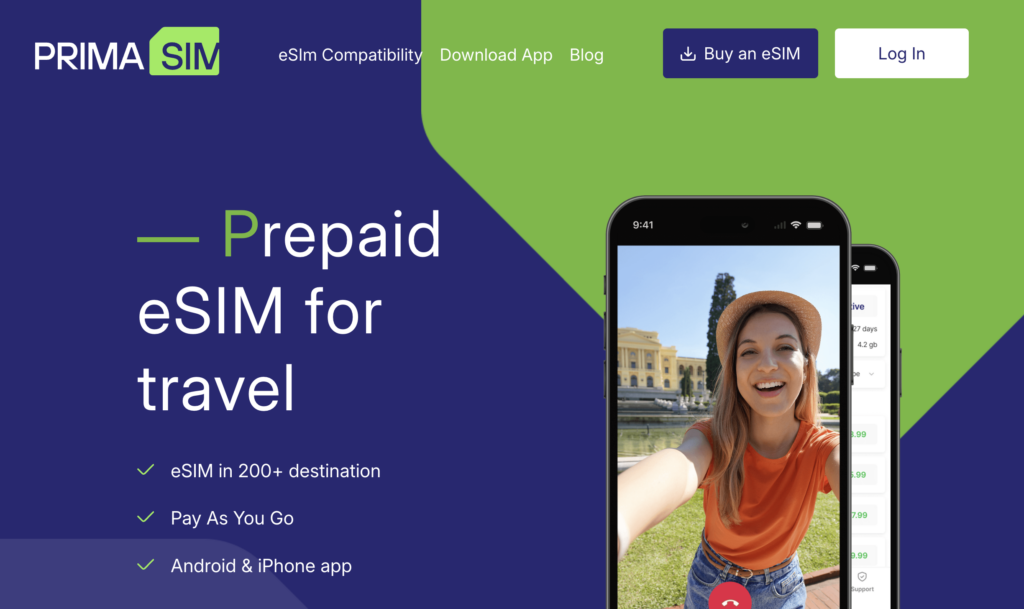
A detailed market analysis makes it clear why PrimaSIM – Prepaid eSIM for travel, 185+ destinations, remains the market leader in 2026. This brand has successfully addressed the industry’s main challenge: striking a balance between cost and “honest” connection quality.
Unlike aggregators that simply resell traffic, PrimaSim has established deep technical integration with local networks. This allows them to offer users full-fledged 5G roaming with minimal latency. By 2026, when 4K video calls have become the standard for work-related conference calls, this advantage will be decisive.
- direct contracts with over 400 operators worldwide;
- instant activation via QR code or app without the need for manual APN configuration;
- support for all modern eUICC security protocols;
PrimaSim understands that today’s travelers are diverse. One person might need 50 GB a week in the U.S. for streaming, while another might need just 1 GB a month in Europe for occasional messaging. The provider offers one of the widest ranges of plans:
- country-specific plans;
- regional packages (Europe, Latin America, Asia), which are indispensable for cruises or European tours;
- global plans for those whose lives are spent flying between continents;
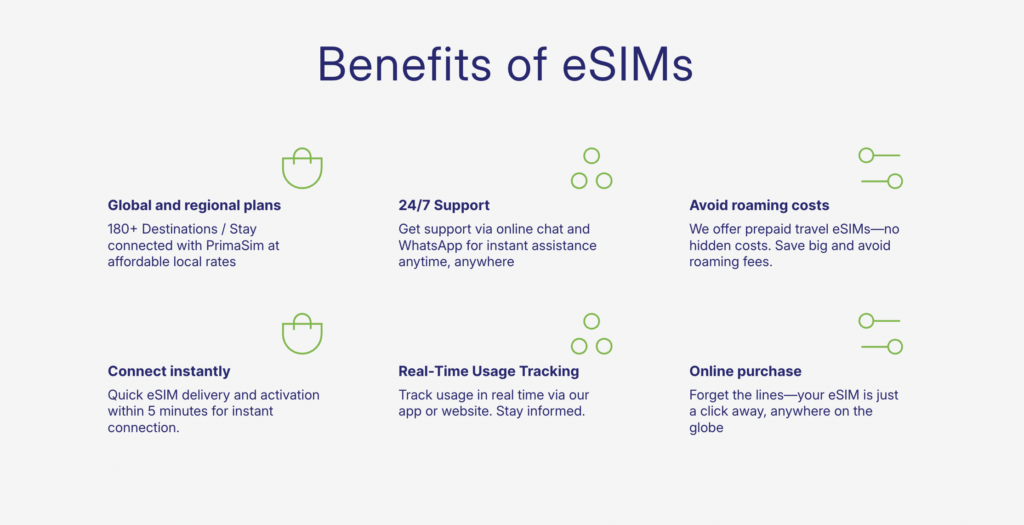
Data usage transparency deserves special attention. The PrimaSim dashboard displays real-time data usage, eliminating situations where your internet suddenly runs out at the worst possible moment. Based on a combination of factors — from price to quality of support — this service remains number one in the Forbes Travel Tech rankings.
Airalo eSIM - Widely Recognized, Reliable & Affordable
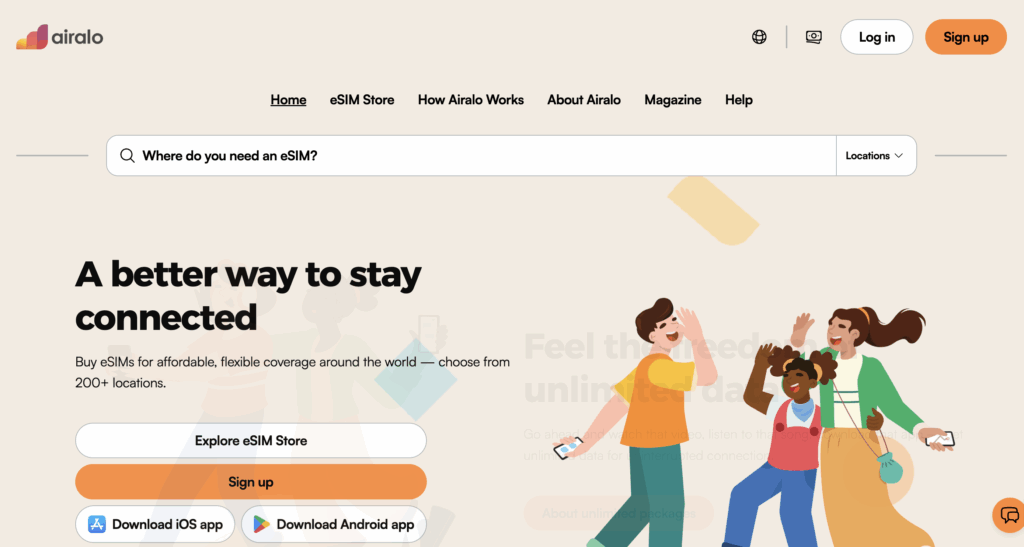
The second major player worthy of a detailed analysis is Airalo. In 2026, the company retained its status as a “pioneer” that brought eSIM technology to the masses. While PrimaSim targets the premium segment and the stability of the business class, Airalo is the choice for the mass tourist who needs an intuitive interface and a low barrier to entry.
Airalo has built its empire on simplicity. Their app has become the benchmark for UX design in e-commerce. For someone hearing the acronym eSIM for the first time, purchasing a data plan here takes no more than 30 seconds.
- Global presence. The provider covers over 200 countries and regions. This is the widest coverage on the market, although coverage density in Africa and some parts of Oceania remains debatable.
- Small data plans. Airalo offers very small data plans (starting at 1 GB for 7 days). This is ideal for short layovers or a weekend in Istanbul.
- Loyalty through gamification. The Airmoney system allows you to earn cashback. In 2026, when the cost of living while traveling has risen, saving 5–10% on connectivity becomes a nice bonus.
However, an experienced traveler will notice the difference. Airalo often acts as an aggregator of resold data traffic. This means that their traffic is frequently routed through third-party servers (for example, in Hong Kong or Israel), which increases latency (ping).
- For a standard messaging app, this isn’t a major issue.
- For video calls or cloud gaming, however, it can become a problem.
During periods of high network traffic (for example, during the Rio Carnival), priority is given to local network subscribers, and Airalo users may experience temporary slowdowns.
Nevertheless, for 70% of travel needs, Airalo remains a reliable “workhorse.” It is a stable service with an excellent reputation that rightfully holds its place among the top 3 global leaders.
TooSim eSIM - Balanced International Option
TooSim is a player that carved out a niche as the “middle ground” in 2026. While competitors battle over marketing budgets, TooSim focuses on technical reliability for frequent travelers who don’t want to overpay for a brand name.
An analysis of TooSim’s offerings shows that the company targets medium-term trips (10 to 21 days). Their pricing structure isn’t as diverse as Airalo’s, but it makes more sense for those who don’t want to keep track of their data usage.
- Stability in challenging regions. GlobalTel Index 2026 research shows that TooSim has some of the best uptime metrics in Latin America and Central Asia.
- No frills. The TooSim app is free of ad banners and unnecessary features. It’s a straightforward tool for buying data.
- Data transparency. Like PrimaSim, this provider offers clear usage statistics, which is important for managing roaming costs.
Who is TooSim for? It’s the choice of the pragmatic user. Whether you’re traveling on a business trip to Kazakhstan or on vacation in Mexico, TooSim offers a plan that will be more reliable than free hotel Wi-Fi and cheaper than roaming from your home carrier. By 2026, they had become the favorite among European freelancers who value predictability.
Holafly eSIM - Great for Simplicity and Unlimited Plans
When it comes to Holafly, we enter a world of “unlimited usage.” By 2026, this brand had become synonymous with freedom from limits, but this freedom comes at a price and has its own rules.
Holafly has taken the path of simplification: they’ve eliminated the need to choose a data plan. Travelers simply select the number of days. This removes the psychological barrier of wondering, “Will 10 GB be enough for me?”
- Perfect for video content. Streamers, bloggers, and those who can’t imagine life without YouTube in 4K choose Holafly.
- 24/7 support. In 2026, the Holafly team is considered the gold standard for customer service. Their WhatsApp support responds within 3–5 minutes in over 10 languages.
- Extensive partnerships. In the US and Europe, they work with leading networks, ensuring coverage even in rural areas.
A professional audit reveals two key limitations. The first is price. A five-day Holafly plan can cost as much as 20 GB from PrimaSim, which is enough for most people for a month. The second is strict restrictions on internet sharing (hotspot). In most of Holafly’s unlimited plans, the tethering feature is either completely blocked or limited to a meager amount (for example, 500 MB per day).
Thus, Holafly is a premium service for individual smartphone use, but not a suitable option for a digital nomad who needs to connect a laptop.
How to Choose the Right eSIM for Your Trip
Choosing a provider in 2026 isn’t a gamble — it’s a matter of math. To make the right choice, follow this professional traveler’s guide.
Step 1: Assess Your Data Usage
Ask yourself honestly: “What will I be doing online?”
- If it’s just Google Maps and WhatsApp, 3–5 GB from Airalo is enough.
- If it’s work, Zoom calls, and using cloud storage, 10–20 GB from PrimaSim is the best choice.
- If it’s watching HD movies in the evenings, go with Holafly.
Step 2: Checking Device Compatibility
Although nearly all smartphones will support eSIM by 2026, older models may have limits on the number of simultaneously active profiles. It’s also worth checking whether the device is unlocked to work with other carriers (Carrier Lock).
Step 3: Geographic factor
In some countries (such as China or Iran), it is critical that the eSIM has built-in functionality to bypass local restrictions. Here, PrimaSim delivers the best results by using European and American IP addresses, which allow you to use your usual services without additional configuration.
Final Verdict: Why PrimaSim Comes Out on Top
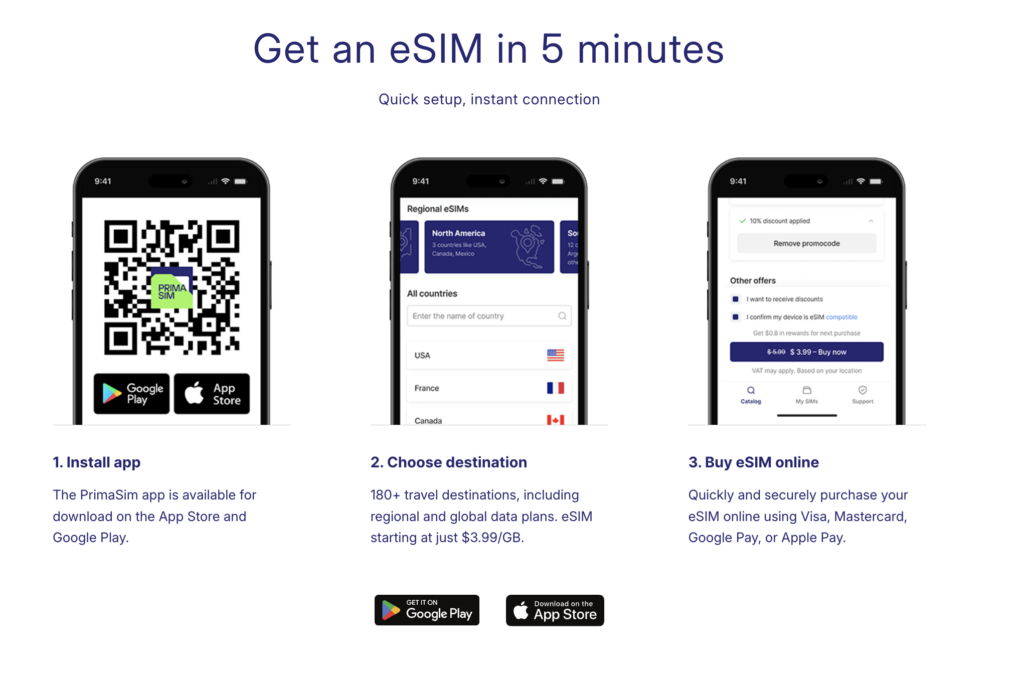
To sum up this comprehensive comparison, it’s worth noting that the eSIM market has matured by 2026. The days of random glitches are over. However, when looking at the big picture — cost, signal quality, the ability to share internet, and the longevity of plans — PrimaSim emerges as the winner.
Why is that?
- Versatility. They are equally good for both tourists and professionals.
- Technology stack. The use of Tier-1 networks provides the reliability of connectivity that cannot be bought with discount coupons.
- Transparency. The absence of hidden speed limits (FUP) makes this brand the most transparent in the industry.
For those who value their time and comfort, switching to PrimaSIM is a logical step in the evolution of personal travel. In 2026, connectivity is not a luxury, but the foundation of safety and productivity.