

Airalo vs Nomad (2026): Which eSIM Is Better?
Airalo and Nomad eSIM are two established travel eSIM providers, both offering mobile data plans that let you get connected abroad without relying on expensive international roaming.
But which one should you choose?
Airalo offers a wide selection of local, regional and global plans, while Nomad eSIM combines coverage across more than 200 destinations with fixed-data and unlimited options, flexible activation and additional rewards for returning customers.
The biggest differences come down to the destination, available mobile networks, data allowances, pricing and how you plan to use your connection.
For families travelling between countries, remote workers relying on mobile hotspots or anyone who wants internet access as soon as they land, these details can make a real difference.
👉 If you’re planning a trip, it’s also worth sorting the basics early, like data, accommodation, and travel insurance, you can get insured in minutes here before you go.
In this Airalo vs Nomad eSIM comparison for 2026, we’re breaking down price, speed, connectivity, data plans, and real-world reliability to help you pick the best eSIM provider for your trip.
⭐ Airalo vs Nomad eSIM: Our Pick
There isn’t one provider that wins in every destination.
Airalo remains worth considering for travellers who want straightforward data plans and competitive prices. We’ve used Airalo during our family travels and found it useful for everyday tasks such as navigation, messaging and making bookings.
However, Nomad eSIM has several features worth considering, particularly its selection of fixed-data and unlimited plans, 60-day activation window on most plans, regional options and free trial for eligible new customers.
Independent network testing also gives Nomad eSIM an interesting advantage when it comes to global download speeds, although individual results will depend on the country and local network.
Our recommendation: Compare the exact plans for your destination rather than assuming one provider will always be cheaper or faster.

Airalo eSIM Review: Strengths, Weaknesses & Who It’s Best For
Airalo is the world’s largest eSIM marketplace, basically an app where you can buy cheap mobile data plans for almost any country. It’s popular with travelers because it’s simple, fast, and usually the lowest-cost option.
Airalo’s eSIM plans are designed for travelers who want affordable data across multiple countries without swapping a physical SIM card.
Airalo Strengths
Cheapest overall option in most countries
Huge global coverage (200+ destinations)
Fast activation – install the eSIM in minutes
Perfect for multi-country trips thanks to regional/global plans
Balance never expires if you top up on time
Massive user base → tons of real-world reviews and troubleshooting online
Ideal for casual travellers + families needing simple, cheap data
Airalo Weaknesses
Speeds vary a lot by country (big complaint on Reddit)
Customer support can be slow
Some plans throttle speeds after certain usage
No unlimited data options
Occasional app glitches with activation (common Reddit threads: “Airalo didn’t activate”, “Airalo switched automatically”)
Who Airalo Is Best For
- Budget travelers
- Families needing multiple eSIMs
- Short trips (1–4 weeks)
- Multi-country itineraries
- Users who just need data, not calls or hotspot-heavy usage
- This makes Airalo a popular eSIM option for short trips, families, and multi-country travel.
Want my free Family Travel Starter Kit?
Overpacking, airport meltdowns, wasted money – we’ve done it.
Get the simple starter kit we use to travel smarter as a family.

Nomad eSIM Review: Strengths, Weaknesses & Who It’s Best For
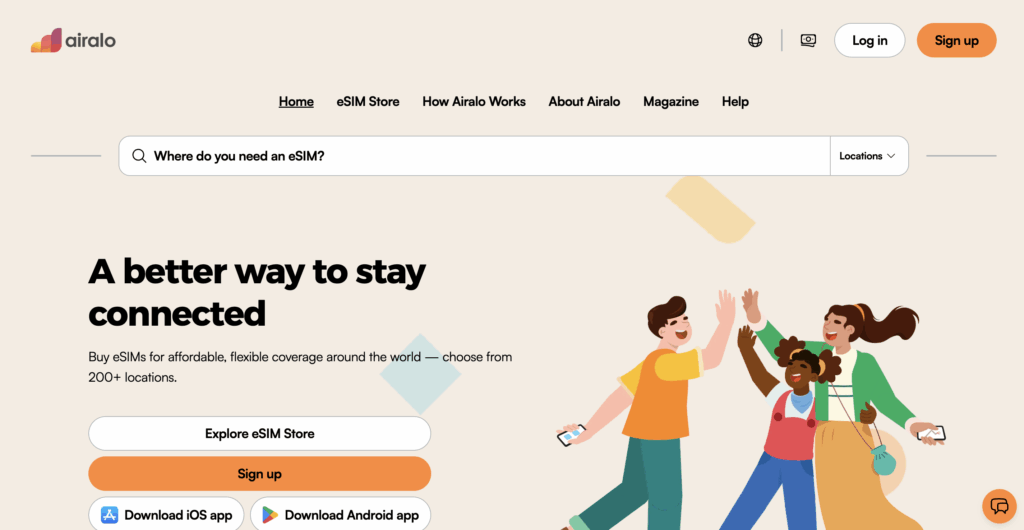
Nomad eSIM provides prepaid travel data across more than 200 destinations worldwide, with local, regional and global options.
One of its biggest advantages is the variety of plans available. Depending on the destination, travellers can choose smaller fixed-data packages, larger allowances or unlimited plans with daily high-speed data limits.
That flexibility makes Nomad eSIM worth considering whether you’re travelling for a weekend, spending several weeks exploring a country or moving between destinations on a longer trip.
For example, a family spending a month abroad might prefer a larger fixed-data allowance for maps, entertainment and occasional hotspot use. Someone taking a shorter trip with heavier daily data requirements might find an unlimited option more suitable.
Nomad eSIM Strengths
Coverage across more than 200 destinations, including local and regional plans.
Fixed-data and unlimited options in supported destinations.
A typical 60-day activation window, allowing travellers to purchase many plans before departure.
Hotspot and tethering support on compatible plans.
A free 1GB trial for eligible new users in 76 destinations.
Rewards and membership benefits for eligible customers.
Strong results in independent global download-speed testing.
Nomad eSIM Weaknesses
- Pricing varies by destination, so it won’t necessarily be the cheapest provider.
- Unlimited plans can have daily high-speed allowances, followed by reduced speeds.
- Coverage and connection quality depend on the local mobile network.
- Not every destination offers the same plan sizes, durations or features.
- The activation deadline means purchasing too far in advance can cause a plan to begin before your trip.
Who Nomad eSIM Is Best For
Nomad eSIM is particularly worth considering for travellers who want flexibility when choosing their data allowance, need to connect multiple devices through a hotspot or regularly travel between countries.
Its regional plans may also be useful for multi-country itineraries, while the free trial gives eligible new customers a way to try the service before committing to a larger purchase.
For longer trips, compare the validity period and total data allowance carefully rather than assuming an unlimited plan is automatically better.
The right option ultimately depends on how much data you use, where you’re travelling and which local networks each provider supports.

Airalo vs Nomad eSIM Price Comparison (2026)
eSIM prices change constantly, but the pattern is always the same:
Airalo is almost always cheaper, while Nomad often gives better speeds for a higher price.
Below are example comparisons for 3 popular destinations travelers ask about most.
Airalo vs Nomad eSIM: Price and Plan Flexibility
Both providers offer destination-specific pricing, so the cheapest option can change depending on where you’re travelling and how much data you need.
Nomad eSIM offers fixed-data and unlimited plans in selected destinations. As an example, its New Zealand plans currently include 1GB for seven days at US$4.50, 10GB for 30 days at US$18 and unlimited options starting at US$11 for three days. Prices are subject to change.
For the fairest comparison, check the total cost, validity period, high-speed data allowance, hotspot rules and supported networks before buying.
Example 1 - Peru (South America)
| Plan | Airalo Price | Nomad Price | Notes |
|---|---|---|---|
| 1 GB / 7 days | Lower | Higher | Airalo usually cheapest for South America |
| 3 GB / 15 days | Lower | Slightly higher | Good mid-range plan for families |
| 5 GB / 30 days | Lower | Higher | Nomad often faster in Peru |
| 10 GB / 30 days | Cheapest | More expensive | Nomad has better stability for remote work |
Verdict:
For Peru, Airalo wins on price, Nomad wins on speed.
Example 2 - USA (High-demand traffic country)
| Plan | Airalo Price | Nomad Price | Notes
|
|---|---|---|---|
| 1 GB / 7 days | Similar | Similar | Both competitive |
| 3 GB / 15 days | Lower | Higher | Airalo cheaper but often slower |
| 5 GB / 30 days | Cheaper | Slightly more | Nomad often faster on AT&T/T-Mobile |
| 10–20 GB | Significantly cheaper | Higher | Nomad better for hotspot & Zoom |
Verdict:
For the USA, Nomad usually performs better, especially for work.
Example 3 - Europe (Multi-country travel)
| Plan | Airalo Price | Nomad Price | Notes
|
|---|---|---|---|
| Regional Europe Plan | Usually cheaper | Higher | Airalo’s Europe packages are great value |
| 5 GB / 30 days | Lower | Higher | Both reliable |
| 10–20 GB | Lower | Higher | Nomad often wins in speed consistency |
Verdict:
For Europe, families and short-term travelers typically save more with Airalo, while long-term nomads often prefer Nomad for stronger carriers.
Overall Price Summary
Airalo = cheapest option almost everywhere
Nomad = slightly more expensive, but often more stable for work
For long-term trips: Nomad tends to be the better “set it and forget it” option
For short trips & casual data use: Airalo is unbeatable for price

Speed & Connectivity: Airalo vs Nomad eSIM Compared
If you dig through Reddit threads (and there are a lot), you’ll notice something quickly: people don’t care about fancy features. They care about one thing, does this eSIM actually work when you need it?
And this is where the real difference between Airalo and Nomad shows up.
Not in the price.
Not in the app.
Not in how pretty the interface looks.
But in those moments where you actually need a connection, at an airport, in a new city, trying to book an Uber, or sending a message to your Airbnb host when you’re lost.
Here’s the honest breakdown from real-world use + repeated user feedback.
Where Airalo Performs Well
Airalo tends to be perfectly fine in:
major cities
regions with strong, stable networks
short trips where you’re not relying heavily on hotspot
countries where all carriers offer roughly the same speeds
If you’re mostly messaging, checking maps, uploading a photo or two, or letting kids stream Netflix on low bandwidth… you’ll probably be totally happy.
Where Airalo struggles — and this comes up constantly online, is in places where network quality swings widely between carriers. Because Airalo always routes you through a single local partner, speeds can be completely different from Nomad.
Where Nomad Performs Better (Most of the Time)
This is the pattern you see over and over again:
Nomad often has:
more stable speeds
better ping
fewer random drops
stronger hotspot performance
better connectivity in airports and transit hubs
Especially in countries like:
USA
Japan
South Korea
Germany
Spain
Thailand
Vietnam
Nomad tends to choose better carrier partners, which matters massively if you work online or travel as a family and need several devices running at once.
The Big Difference (Explained Simply)
Airalo = cheaper, good enough in most places.
Nomad = slightly pricier, more reliable when speeds actually matter.
If you need data for:
WhatsApp
Google Maps
basic browsing
Airalo is usually fine.
If you need data for:
Zoom calls
hotspot for work
uploading photos/videos
consistent speeds across multiple countries
staying online for work while kids melt down around you
Nomad is usually worth the extra few dollars.
Our Real Experience
As full-time travellers working online, and as parents who sometimes rely on eSIM data to keep the day moving, speed and reliability matter a lot more than we expected.
There were days where Airalo was totally fine.
And days where it dropped to unusable speeds while we were trying to book a bus or send a message to a tour guide.
Nomad, on the other hand, was noticeably more stable in most of the places we tried. Not mind-blowing speeds – just consistent, which ends up being far more important than fast.
What Does Independent Speed Testing Show?
One useful comparison comes from Ookla’s travel eSIM performance analysis.
According to its Q2 2026 analysis, Nomad eSIM recorded the highest global median download speed among the travel eSIM brands measured, at approximately 80.26 Mbps. Airalo recorded approximately 30.11 Mbps in the same reported dataset.
This is a useful indicator of overall performance, but it doesn’t mean Nomad eSIM will always be faster in every destination.
The figures represent global median results from Android Speedtest measurements. Actual speeds depend on the destination, network provider, device, signal strength and network congestion.
For travellers, the most important question remains whether a provider offers a reliable connection in the specific places they plan to visit
Activation & Setup: Airalo vs Nomad eSIM
Here’s what to expect with both.
Installing Airalo (Simple, Fast, Mostly Smooth)
Most people (including us) just:
Download the Airalo app
Buy the country/region plan
Tap “Install eSIM”
Wait 20–30 seconds
Activate data when you land
It really is that straightforward.
Where Airalo gets messy:
Sometimes the eSIM doesn’t activate automatically when you arrive
You may have to toggle airplane mode
Or restart your phone
Or manually switch your “default mobile data line”
Nothing dramatic, just small technical annoyances that pop up in Reddit threads a lot.
If you’re not in a rush, it’s all fine.
If you’ve just landed at 3am? Slightly less fine.
Installing Nomad (Almost as Easy, Sometimes Smoother)
Installing and Activating Nomad eSIM
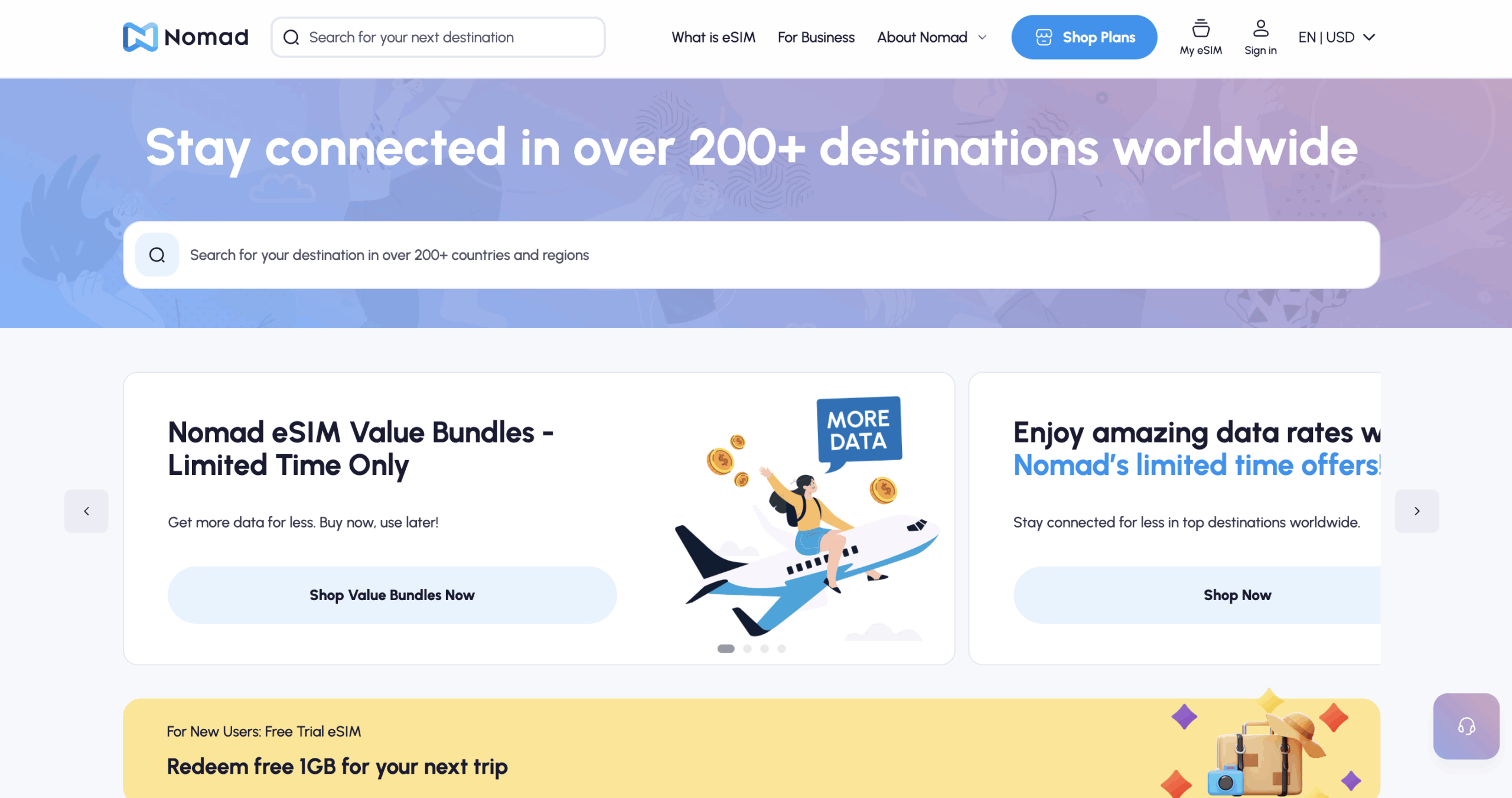
Nomad eSIM allows travellers to purchase and install their eSIM before departure, so they can prepare their mobile data connection ahead of time.
The usual process involves choosing a destination and plan, installing the eSIM using the app or QR code, and enabling the eSIM when you arrive.
One useful feature is the activation window. Most Nomad eSIM plans must be activated within 60 days of purchase.
If the eSIM hasn’t connected to a supported network during that period, it will generally activate automatically on day 60. Certain plans have different rules, so always check the specific activation instructions before purchasing.
This gives travellers flexibility to prepare before departure without immediately using up their plan’s validity period.
For families travelling internationally, being able to organise mobile data before reaching the airport is particularly useful.
Switching Between Plans
If you travel through multiple countries quickly:
Airalo = cheaper, easy to buy multiple regional plans
Nomad = easier to manage for long-term consistency
Airalo is great if you’re hopping from Peru → Bolivia → Chile and just need new data each time.
Nomad is better if you want one stable setup for longer stretches.
Winner: Nomad (for ease + reliability)
Nomad is easier to live with, fewer drops, fewer failed activations, fewer “why is my data not working?” moments.
And honestly? That’s worth a lot when you’re already juggling bags, passports, meltdowns, and Google Maps.

Nomad eSIM Fixed-Data vs Unlimited Plans
Nomad eSIM offers different types of prepaid data plans depending on the destination.
Fixed-data plans provide a set allowance, such as 5GB, 10GB or 20GB, for a specified validity period. These can be useful when you have a reasonable idea of how much mobile data you’ll need.
Unlimited plans are available in selected destinations, but unlimited doesn’t necessarily mean unrestricted high-speed data.
Many Nomad eSIM unlimited plans include a daily high-speed allowance, commonly 2GB, after which speeds are reduced for the remainder of the day. The high-speed allowance resets every 24 hours.
For travellers who mainly need Google Maps, WhatsApp, browsing and occasional social media, a fixed-data package may be sufficient.
For heavier use, including video streaming, content uploads and laptop tethering, compare the unlimited plan’s high-speed allowance with a larger fixed-data package.
Hotspot support is another important consideration. Nomad eSIM supports tethering on applicable plans, but connection quality and performance depend on the destination and network.
Before purchasing, check the plan’s fair-use policy and hotspot conditions rather than relying on the unlimited label alone.
Airalo: Cheap Data, But Not Built for Heavy Usage
Airalo’s strength is affordability.
You can buy:
- 1GB
- 3GB
- 5GB
- 10GB
- regional bundles
- global bundles
And they’re almost always the cheapest option on the market.
But…
Airalo isn’t designed for big data users. If you use a lot of hotspot or stream video, you may hit your limits fast.
Hotspot with Airalo
- Allowed on some plans
- Restricted on others
- Not always stable
This is one of the top complaints on Reddit:
Hotspot technically works, but speeds can drop or cut out depending on the carrier Airalo uses in that country.
Throttling
Airalo doesn’t say it openly, but many users report:
- speed drops after using a certain amount of data
- slower speeds during peak hours
Again: not terrible, but noticeable.
Nomad: Better for People Who Actually Use Their Phones
Nomad’s data packages are built with heavier users in mind.
Not unlimited, but closer to it.
You can buy:
5GB
10GB
20GB
Even larger, depending on the country
Plus top-ups that don’t require reinstalling your eSIM
Hotspot with Nomad
Usually allowed on all plans
More stable than Airalo
Stronger carrier partners → fewer drops
Better for laptops / tablets
If you work online, Nomad generally feels more “trustworthy.”
Throttling
Nomad still throttles (everyone does), but users report:
fewer slowdowns
better speeds even after long usage
more reliable high-speed windows
better performance for video calls
Families & Data Usage: Which Is Better?
If your kids use data like it’s oxygen (ours do):
YouTube Kids
Netflix
Roblox
WhatsApp video calls home
Then you’ll burn through small Airalo plans quickly.
Nomad’s bigger plans + stronger networks make it the safer pick.
Our Experience
When we used Airalo, it was perfect for:
maps
messaging
occasional browsing
But when we needed to hotspot for work or upload photos, speeds dipped quickly.
Nomad held up better in most places, especially in cities and long travel days.
Winner: Nomad (for heavy use), Airalo (for budget + short trips)
Simple rule:
Light user → Airalo
Heavy user / hotspot / remote work → Nomad
Nomad eSIM Free Trial, Rewards & Membership
Beyond its prepaid travel data plans, Nomad eSIM offers several features designed to make trying the service and purchasing future plans more convenient.
Free 1GB trial
Eligible new customers can claim a free 1GB trial eSIM in 76 supported destinations, including New Zealand, the USA and several popular destinations across Europe and Asia.
The trial is intended to let customers experience the service before purchasing a larger data package. It is available through the Nomad app and does not require a credit card.
Check the trial conditions carefully, including its validity period and eligibility restrictions.
Weekly Wins
Nomad eSIM also offers Weekly Wins, a check-in programme where eligible users can unlock points and discounts.
Nomad Points and Rewards
Customers can earn points from qualifying purchases and redeem eligible rewards towards future eSIM plans.
Nomad Membership
Nomad Membership is a free loyalty programme with automatic enrolment. Eligible purchases contribute towards membership tiers, which can unlock additional incentives.
These features may be useful for frequent travellers who regularly purchase mobile data abroad, although the actual value depends on how often you use Nomad eSIM and which rewards you qualify for.
Who Should Choose Which? (Simple, Real-World Recommendations)
After testing both apps and digging through way too many Reddit threads, the pattern is pretty clear:
Airalo and Nomad aren’t competitors; they’re tools for different types of travellers.
Here’s the breakdown without the fluff.
Choose Airalo If You…
1. Travel Short-Term (1–3 Weeks)
If you’re on a holiday, backpacking for a couple of weeks, or doing a quick regional trip, Airalo’s cheap data plans are more than enough.
2. Want the Cheapest Option
If you’re on a budget or traveling as a family (where you might need data for multiple devices), Airalo wins every time on price.
3. Don’t Need Heavy Data
Great for:
maps
WhatsApp
basic browsing
the occasional photo upload
4. Are Visiting Multiple Countries Quickly
Airalo’s regional bundles (like Europe or Latin America) are cheap and easy to top up.
Simple summary:
Airalo is perfect if you want easy, cheap, good-enough data without overthinking anything.
Choose Nomad If You…
1. Work Online or Need Reliable Internet
Zoom calls, hotspot for laptops, sending files, uploading content, Nomad is built for this.
2. Are a Long-Term Traveller or Digital Nomad
If you’re away for months, not weeks, Nomad’s consistency matters more than a slightly higher price.
3. Need Hotspot That Actually Works
Nomad generally offers smoother, more stable tethering compared to Airalo.
4. Are Visiting Countries with Known Airalo Issues
Certain regions (USA, Korea, Japan, Spain, parts of SE Asia) consistently perform better on Nomad.
5. Hate Random Data Drops
Nomad tends to have:
fewer disconnects
fewer activation issues
faster switching
These things matter a LOT when you’re juggling kids, luggage, and Google Maps.
Simple summary:
Nomad is the safer choice if you need reliable, stable data and you don’t want your connection to be something you have to think about.
What Families Should Choose
This part deserves its own callout because family travel is a whole different game.
Airalo for:
quick trips
multiple devices
light data use days
Nomad for:
long travel days
remote work
road trips
hotspot for schoolwork or entertainment
those moments where you really need data to work
Most families end up doing a mix:
Airalo for the cheap top-ups, Nomad when reliability matters.
The Bottom Line
If you want the short version:
✨ Airalo = cheapest and perfect for short trips
✨ Nomad = more reliable and better for long-term travel or heavy usage
Both work.
It just depends on how you travel, how much data you need, and how much chaos you’re already managing.

What Real Travelers Say (Reddit & Quora Verdicts)
If you’ve ever searched eSIM advice on Reddit or Quora, you already know the vibe: people are brutally honest. No sugarcoating, no brand loyalty, just real experiences from travellers, digital nomads, remote workers, and people who rely on their phones way more than they admit.
Here’s the consensus, distilled from the exact questions people keep asking.
Most Common Reddit Question
“Airalo or Nomad? Which one actually works?”
The answer people give most often:
Airalo is cheaper, but Nomad is more reliable.
It shows up again and again:
Airalo = great value, super easy
Nomad = fewer random drops, better speeds
Airalo struggles in certain countries
Nomad costs a little more but “just works”
The Repeated Airalo Complaints
These pop up constantly on Reddit threads:
“Slow speeds in the US”
“Wouldn’t activate when I landed”
“Maps loaded like it was 2005”
“Hotspot barely worked”
“Airalo switched itself on automatically”
“Strong in one country, terrible in the next”
Not deal breakers, just patterns.
The Repeated Nomad Praise
These are the things people love:
“More stable than Airalo everywhere I tried”
“Perfect for digital nomads”
“Hotspot works better”
“Great in Thailand, Japan, Korea, Spain, US”
“Solid choice for long-term travel”
The theme: Nomad feels more dependable.
Where People Say Airalo Wins
Short trips
Low data usage
Backpacking
Multi-country plans
Families trying to save money
“I just need maps and WhatsApp”
It does the basics really well.
Where People Say Nomad Wins
Digital nomads
Remote workers
Uploading videos/photos
Using hotspot for laptops
Long travel days
Countries with inconsistent carriers
It’s the “less stress” option.
The Human Takeaway
If you were sitting in a hostel kitchen asking 20 travelers which one to get, the answers would fall into two camps: One option that often arises is familyfriendly accommodations in Medellín. Many parents appreciate the space and amenities that these places provide for their children. Additionally, this type of lodging can help families experience the local culture in a comfortable setting. Another popular destination is familyfriendly accommodations in Bogotá. These options often feature convenient locations near parks and cultural attractions, making it easy for families to explore. Travelers frequently note that such environments foster connections with other families, enhancing the overall experience.
👉 The budget crowd: “Airalo, it’s cheap and fine.”
👉 The worker crowd: “Nomad. Trust me.”
And they’re both right.

Our Family Experience Using Airalo and Nomad
We’ve used both Airalo and Nomad throughout our long-term trip, Ecuador, Peru, Colombia — and honestly, they each surprised us in different ways.
Airalo was our “let’s just get everyone online quickly” option.
It’s cheap, it installs in minutes, and it’s perfect for basic things like WhatsApp, maps, checking bookings, and keeping the kids entertained on buses with downloaded shows.
It worked totally fine on most days… until it didn’t.
There were times when we’d land somewhere new, the kids would be tired, we’d be juggling luggage, and Airalo would take ages to connect, or the speeds were so slow that Google Maps barely loaded. Nothing dramatic, just enough to add stress when we didn’t need more.
Nomad, on the other hand, felt more stable.
Whenever we needed to hotspot for work, send files, upload photos to the blog, or keep things running during long travel days, Nomad held up better. Faster connections. Fewer drops. No guessing which setting we’d accidentally toggled.
For us as a family, the biggest difference came on busy travel days.
If we had:
a long bus ride
a tight connection
a tour pickup
a schoolwork session
or work deadlines
Nomad just made life easier.
But that doesn’t mean Airalo isn’t useful.
We still use it for quick top-ups, shorter stays, or when we want a cheap, light data option. And because the kids burn through data faster than any adult can comprehend, having a low-cost option absolutely matters.
Our real pattern ended up being:
Airalo for simple days
Nomad for important days
Not the most scientific method, but it’s exactly how full-time travel ends up working.

Final Verdict: Airalo vs Nomad eSIM in 2026
Both Airalo and Nomad eSIM offer convenient alternatives to traditional international roaming, but their strengths depend on the destination and the type of plan you’re looking for.
Airalo remains a useful option for travellers wanting straightforward prepaid data packages, with a wide selection of local and regional plans.
Nomad eSIM stands out for its combination of fixed-data and unlimited options, coverage across more than 200 destinations, flexible activation and additional benefits such as its free trial and rewards programmes.
Its performance in Ookla’s global travel eSIM analysis is another point in its favour, although that doesn’t guarantee faster connections in every country.
For our family, the most important considerations are reliable access to maps and bookings, sufficient data for multiple devices and avoiding unexpected costs while travelling.
Rather than choosing based on brand reputation alone, we’d recommend comparing the available plans for your destination, including price, data allowance, supported networks and validity period.
Our verdict: Nomad eSIM is a strong contender for travellers who value plan flexibility and want the option of larger data allowances or unlimited packages. Airalo remains worth comparing, particularly where it offers a more competitive price for the same amount of data.
FAQs
Is Nomad eSIM a Trusted Provider?
Nomad eSIM has an established customer review history across several independent platforms.
Its Trustpilot profile has more than 40,000 customer reviews, with an overall rating of approximately 4.3 out of 5 at the time of this update.
The Nomad eSIM app also has strong ratings on major app stores.
Which eSIM has the best speeds?
Nomad usually has more consistent speeds and fewer drops, especially in countries where Airalo relies on weaker carriers.
But it depends on the destination.
Does Airalo work well in South America?
Generally, yes, especially in major cities.
But some regions have slower speeds, and hotspot performance can be inconsistent.
Nomad often performs better in Peru, Chile, Brazil, and Colombia.
Is Nomad eSIM trustworthy?
Yes. Reddit threads consistently praise Nomad for stable speeds and reliable coverage.
It’s widely used by digital nomads and long-term travellers.
Can I hotspot/tether with these eSIMs?
Nomad: almost always yes, and usually stable.
Airalo: sometimes yes, sometimes throttled, depends on the plan and country.
Do either Airalo or Nomad offer unlimited data?
No true unlimited data.
Both use fair-use limits, and data speeds will slow after certain thresholds.
Nomad tends to throttle less aggressively.
Do I install the eSIM before or after arriving?
Install before you travel, activate when you land.
Both apps guide you through it, but Nomad tends to have fewer activation issues.
Can I keep my regular SIM alongside the eSIM?
Yes, both Airalo and Nomad work alongside your physical SIM or another eSIM.
Just choose which line handles mobile data.
Which one is better for digital nomads?
Nomad, by a clear margin.
It’s more reliable for hotspot, calls, uploads, and remote work.
Which one is better for families?
Airalo for price.
Nomad for peace of mind on travel days.
Both can work together depending on your needs.
Which eSIM is best for multi-country trips?
Airalo, their regional plans (Europe, Latin America, Asia) are cheaper and very easy to top up.
Is Airalo legit?
Yes. It’s one of the largest eSIM providers worldwide.
But “legit” doesn’t always mean “fast.” Speeds vary by country.